Elias Wegert
Technische Universität Bergakademie Freiberg
Traces of Bernhard Riemann
On September 17, 2026, we celebrated the 200th anniversary of Bernhard Riemann’s birthday.
Though the scope of Riemann’s work is not very extensive, his ingenious ideas have revolutionized parts of mathematics and laid the foundation for new fields of research which remain active to this day.
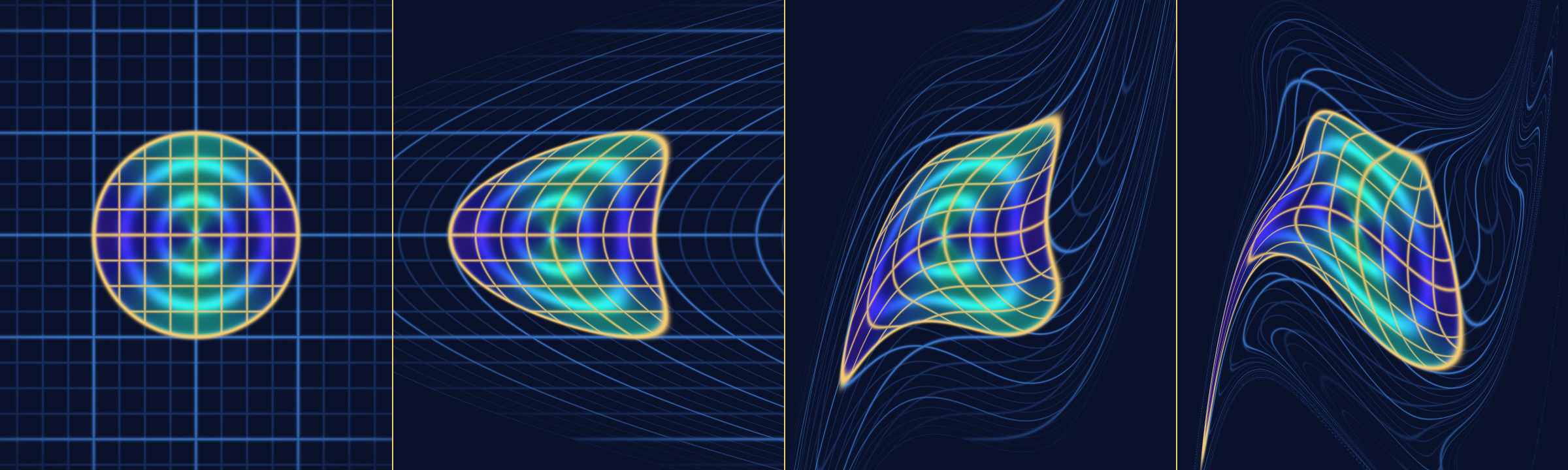
The talk focuses on an early contribution of Riemann: In his 1851 PhD thesis he established a new paradigm for the investigation of complex functions. This comprises, but is not limited to, the class of problems that are today commonly referred to as “Riemann–Hilbert problems”.
Although Riemann’s general plan went largely unnoticed – even by historians – it has since been realized to a certain extent; interpreted generously, a number of important results can be subsumed to it. Other challenging problems remain open until today.
We explore how “Riemann’s project” appeared in his original manuscripts and publications and follow some later developments.
Peter Heinzner
Ruhr-Universität Bochum
Complex geometry of Hamiltonian actions
Over the last 50 years, methods from symplectic geometry have been successfully applied to the study of transformation groups. The core idea is physically motivated, with Noether’s principle playing a decisive role. In classical mechanics, this means that the continuous symmetries of a physical system correspond to conserved quantities. The associated concept of a momentum map has led to new results regarding the behavior of transformation groups in complex geometry. In this talk I will present several examples.
Hanspeter Kraft
Universität Basel
Automorphism groups of varieties – a survey
In 1963 Whittaker showed that a “nice” topological space X is determined by the group Autcont(X) of continuous automorphisms. This means – at least theoretically – that every property of X is “contained” in this group. This cannot hold in the algebraic setting, because there are many nice varieties with trivial automorphism group. Nonetheless the questions remain: What kind of information about X can we retrieve from Aut(X)? Is there a kind of algebraic structure of Aut(X)? What are the algebraic subgroups? When is X determined by Aut(X)?
We will give a survey on the setup and some recent results.
Tobias Ekholm
Uppsala University and Director of the Institut Mittag-Leffler
Holomorphic curve counts with values in knot invariants
The straightforward Gromov–Witten approach to enumerative geometry of pseudo-holomorphic curves in symplectic Calabi–Yau 3-folds with Lagrangian boundary condition is obstructed by wall crossings. The wall crossings can be identified with the HOMFLY skein relations from quantum topology of knots. Therefore, if curves are counted by the HOMFLY invariants of their boundaries, the count is deformation invariant. We explain this and give several applications in enumerative geometry and knot theory.